
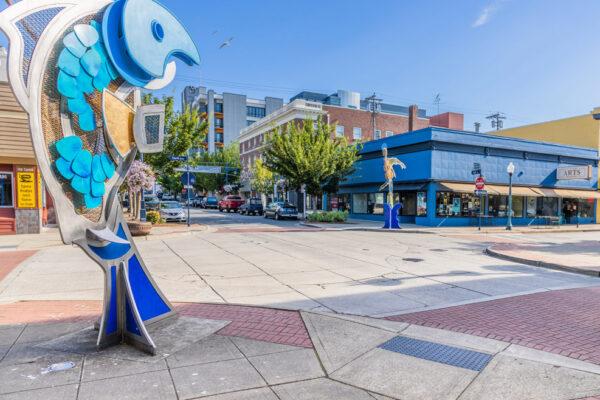
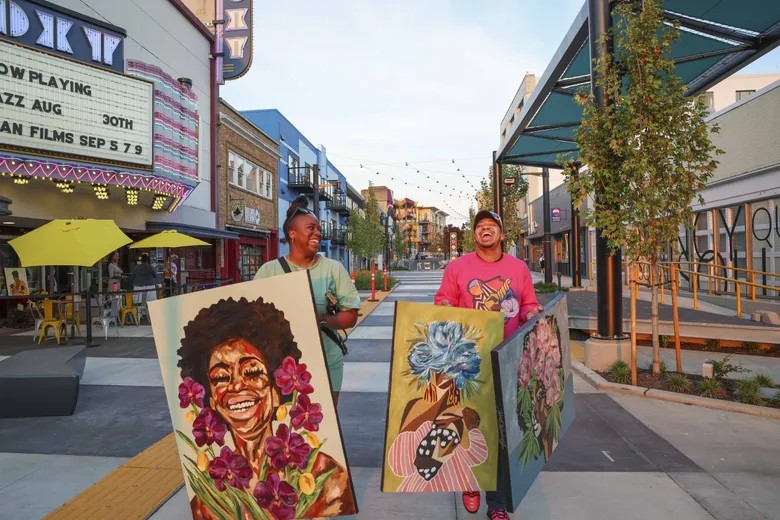
It was Bremerton that gave Quincy Jones his musical origin story. Now, the music titan’s legacy could deliver Bremerton’s next chapter. It’s the city where he touched his first piano, and those magical keys are the foundation of Quincy Square, Bremerton’s $5.5 million project to revitalize its largely lifeless downtown. The city is at a pivotal moment: Quincy Square opened July 12, a month after the city’s two-boat ferry schedule was restored and a year before it will host one of nine official “fan zones” for the FIFA World Cup. Fourth Street, just three blocks from the ferry terminal, was repaved with black and white tiles and adorned with colorful furniture and interactive music installations.
Jones is beaming and wreathed in sheet music on a vibrant orange, yellow and purple mural at the corner of the square. Illustrated alongside him on
the four-story art piece are Ray Charles and Michael Jackson, some of his most famous collaborators. But local Black activists say it’s the lesser-known African American men and women, portrayed on the ground level of the mural, who are at the heart of Bremerton’s hopeful revival. Among them are Lilian Walker, a civil rights activist; Roosevelt Smith, an archivist; and Marty Crutcher, one of Bremerton’s first Black City Council members. For decades, Bremerton’s Black activists fought to give the city’s African American pioneers their day in the sun. The city is trying to achieve that with Quincy Square, while also honoring Jones and breathing life back into downtown. Balancing all three is a delicate art.
Erasure of Black history, one displacement at a time
Jones, who died in November, was 10 years old when he moved with his family to Bremerton in 1943. World War II had drawn thousands to the city for
work at the Puget Sound Naval Shipyard, including Jones’ father. The city’s population more than quintupled during that time and the Black population
boomed in particular, reaching nearly 10,000, as Black families moved in from Chicago and the upper Midwest. Many Black families had already been squeezed from downtown Bremerton at the turn of the century when the city’s founder, William Bremer, developed the waterfront to build the shipyard, said historian and activist Akuyea Vargas. When the war began, they were pushed out almost entirely. Nine new housing projects were built to accommodate the city’s growth, but white residents objected to living next to Black families, so segregated housing was built in Sinclair Heights on the west side of the city. In his 2001 autobiography, Jones recalled that “there were no playgrounds, no swing sets, no marbles, no monkey bars: just miles and miles of towering evergreen trees, cougars, and wilderness.” The units were small and didn’t have telephones or public transportation. Residents walked about 3 miles to the shipyard. But Sinclair Heights did a have a community center with an upright piano. A teenage Jones and his friends sneaked in to scarf down some lemon meringue pie and ice cream cones, he said in 2016 on “The Late Show with Stephen Colbert.” That’s where he played his first notes. “I touched it,” Jones said. “And every cell in my body said this is what you’re going to do the rest of your life.”
The community center became a cultural hub for the Black community. Residents set up voting booths, book clubs and sports games inside. It was there
that Lilian Walker formed Bremerton’s branch of the NAACP to fight segregation and discrimination. When the war ended, Sinclair Heights was destroyed and its units were auctioned off. County officials did so despite knowing the development’s unraveling would dismantle a central Black community hub, researchers from the University of Washington wrote. Jones’ family joined many from Bremerton’s Black population in departing for Seattle. Jones commuted from his new home near Garfield High School to Bremerton on the Kalakala ferry to stay in school there before entering Garfield as a sophomore. But others stayed, including Walker, who continued to push the city to do better by its Black residents and document their history.
Those who stayed dispersed throughout surrounding neighborhoods in West Bremerton. By then, downtown had become a commercial center, said
Kitsap History Museum executive editor Lisa Hope, and racial prejudice deterred Black families from settling in white neighborhoods. Racially
restrictive covenants in housing deeds, which are pervasive across the U.S., excluded Black families from owning homes in numerous subdivisions.
Today, Black families are less than half as likely to own a home in Bremerton as white families. Those odds are about the same in King County.
Sinclair Heights’ former location is now a stretch of car dealerships. It mostly exists now in historian Vargas’ archive, originally compiled in part by
Walker during the 1970s. Vargas keeps the files and artifacts at the Living Arts Cultural Heritage center in Tacoma’s Evergreen College.
She hopes Quincy Square can provide fertile ground to plant that history at home.
Where economic development meets cultural recognition
Some of the city’s Black leaders worry their history is being exploited for the city’s financial gain, while others see it as a long overdue success. Fourth Street used to be a hub. It hosted Bremerton’s City Hall, Fire Department and Police Department in the early 1900s, Kitsap History Museum head
Hope said. It began to develop in the 1920s as houses were knocked down in favor of businesses like Sears and the city’s first four-story office building. But when the Kitsap Mall opened in Silverdale in 1985, downtown businesses migrated north and left Bremerton a “ghost town.”
The city has tried to revive its downtown numerous times, Hope said, but nothing has stuck. For now, she’s “crossing fingers.”
Today, downtown Bremerton has little retail and a 26% vacancy rate, but Quincy Square is beginning to attract business, said Jessica Combs, executive
director of the Downtown Bremerton Association. Two stores are relocating to the square and a vacant space is being considered for a YMCA child care and a new location for the Music Discovery Center, where Bremerton Mayor Greg Wheeler hopes the city can empower “the next Quincy Jones” to find their passion. The city recently closed the street to car traffic on weekends and streamlined permitting to allow performances and showcases on the square’s permanent stage as well as pop-up shops during Bremerton’s World Cup “fan zone.”
Since Quincy Square’s opening, people have begun to slow down and drink the space in, said Michael Goodnow, City Council member and executive director of the Roxy Theatre, a staple of downtown Bremerton. A month after the opening, the theater hosted a panel for Black Breastfeeding Week. Line
dancing broke out in the street as they wrapped. But Vargas wants to see some of Quincy Square’s resources and economic development going back to the African American community it evolved from. She wants to see Black-owned businesses, not just cultural heritage markers.
Black leaders had their own idea for economic development while a revitalization of downtown was being discussed circa 2015, Vargas said. The plan would have seen the construction of a Living Arts Cultural Heritage Center building to serve as a “cultural hub” erected four blocks from Quincy Square on the same campus as the Marvin Williams Center, a community center opened in 2018 for people of diverse backgrounds to gather. Like Quincy Square, the development would have centered Black history in an attempt to inject downtown Bremerton with some newfound life, but it would have been led by the African American community, Vargas said. The city went a different way.
At a community meeting in 2020, Vargas and then-NAACP Bremerton chapter President Tracy Flood raised concerns that people of color were being
“left out of the conversation” in the planning of Quincy Square. Historian Roosevelt Smith said he felt like the project had been “hijacked.” The city launched a series of outreach meetings and issued invitations for more input from people of color, Wheeler said. Wheeler said there is no specific focus on attracting Black businesses to Quincy Square. Rather, he hopes the project’s messaging on inclusivity will invite interest from diverse groups.
He said he’s already seen visitors inquiring about little-known Black history at the mural. And in the next few weeks, more depictions of Sinclair
Heights and Jones’ early life will be added via six interpretive signs throughout the square and at the base of a large woven bronze sculpture of Jones’
face. “Quincy Square is a step in the right direction,” said Robert Harris, president of the Bremerton NAACP chapter, which has been “extremely excited”
about the project. “It’s impossible to capture all of the contributions from all of our Black and brown and Indigenous community members.”
Until Vargas’ collection of Bremerton’s Black history makes its way back to the city, Hope wants to host it for a temporary exhibit called “Black Voices”
in the Kitsap History Museum on Quincy Square. It would only “fill a gap,” but the exhibit would give Bremerton’s Black community the platform to
“tell their own stories their own way in their own voice.” The temporary exhibit will go in the mezzanine, right above an old Melville Clark upright piano that sits in the museum lobby. Its keys are chipped and worn with time. The wood paneling is scuffed and worn, the mechanisms that once made it a player piano removed. Said to be the piano that Jones played in Sinclair Heights, an instrument with such historical significance might find itself behind panes of glass or a red rope. But any visitor can set their fingers on the same keys that drew Jones to his craft like a magnet. Anyone can touch the history at the heart of Quincy Square.